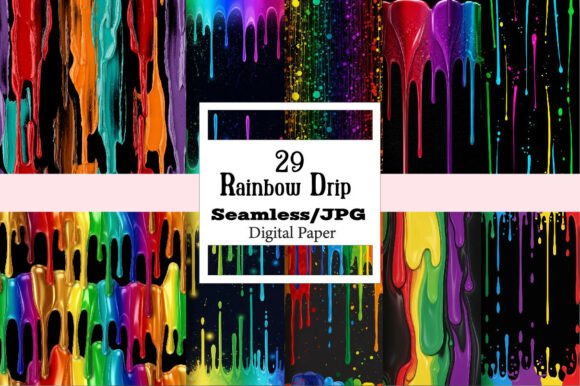
Rainbow Drip Seamless Digital Paper: A Vibrant Toolkit for Creative Expression
At its core, Rainbow Drip Seamless Digital Paper is a versatile graphic asset—a seamless, tileable pattern featuring vibrant, flowing color drips. Its true value lies not just in its aesthetic, but in its function as a foundational layer for countless projects. Many creators initially see only a pretty background, overlooking its engineered purpose: the seamless repeat. This means the pattern edges match perfectly, allowing it to tile infinitely without visible breaks, creating a continuous, professional-looking surface for large-scale prints or digital canvases.
The High-Resolution Foundation: Why 300 DPI Is Non-Negotiable
A common oversight is downloading digital paper without verifying its resolution. The specification of 300 DPI (dots per inch) is crucial for print applications like personalized pillows, tote bags, or sublimation onto tumblers. Using a low-resolution file for these projects results in blurry, pixelated outputs that undermine the quality of your craft or product. Always confirm the DPI before use. For purely digital projects like social media backgrounds or website graphics, lower resolution can sometimes suffice for performance, but starting with a high-res master file like this Rainbow Drip Seamless Digital Paper gives you the flexibility to resize down without quality loss.
Understanding Format and Application Match
The provided JPG format is versatile, but understanding its best-use cases prevents disappointment. JPG is excellent for full-color prints, sublimation, and digital displays. However, for projects requiring precise, crisp cutting lines—like for sticker sheets or intricate scrapbook decoupage—a vector format (like SVG) would be more ideal. Since this pack is JPG, a better approach for precise cutting is to ensure your design software allows you to create clear cut-lines or borders around the pattern. Don't force the file into an unsuitable role; instead, leverage its strengths in color-rich, seamless coverage.
Resizing Wisely: Avoiding Distortion and Artifacts
The note that dimensions can be resized is a powerful feature, but misused it can degrade your project. Enlarging a file significantly beyond its original dimensions can introduce softness and artifacts. A more effective method is to plan your final output size early. If you need a very large print, such as for party decorations or wall art, consider using the seamless tile property: duplicate and tile the pattern within your design software to cover the area, rather than stretching a single instance. This maintains crispness and detail.
The Instant Download Trap: Skipping the Pre-Use Checklist
The convenience of an instant digital download can lead to an immediate jump into creation, bypassing essential checks. After downloading, open the file in your preferred graphics program first. Verify the seamless repeat by tiling two copies side-by-side to check for continuity. Also, inspect the color consistency under different screen brightness settings; colors meant for sublimation might look different on screen versus after heat press. This simple five-minute pre-flight check saves hours of wasted materials on misprinted candle labels or soap product labels.
Beyond Backgrounds: Unlocking Multifunctional Use
A narrow mindset is to use Rainbow Drip Seamless Digital Paper only as a flat background. Its texture and movement make it perfect for foreground elements. For instance, when designing trendy social media graphics, use a cropped section of the drip pattern as a vibrant frame or overlay to highlight text. For KDP (Kindle Direct Publishing) book covers, the pattern can be used selectively on specific areas (like the spine or title block) rather than the entire cover, creating dynamic emphasis without overwhelming the design.
Color Management for Different Outputs
A subtle mistake is assuming the vibrant colors you see on screen will translate identically to all mediums. Sublimation onto mugs or t-shirts, printing on fabric for tote bags, and digital display on websites all have different color profiles. For physical prints, do a small test print if possible, or consult your printer's color guidelines. For digital use, convert the file to sRGB color profile, which is standard for web and monitor display, ensuring your website graphics or digital presentations look consistent across devices.
Planning Projects with the End Use in Mind
Before starting a project like designing mini junk journals or playing cards, consider the final assembly. The seamless nature of the paper is ideal for wrapping tumbler wraps or creating continuous patterns on notebooks, but for a junk journal with many small, separate elements, you might want to crop and isolate smaller sections of the pattern to create variety across pages. Pre-planning how the pattern will be applied—as a continuous wrap versus discrete pieces—guides your design process efficiently.
Integrating with Other Design Elements
Creators sometimes layer text or other graphics onto busy patterns without considering legibility. The Rainbow Drip pattern, while beautiful, has high color contrast. A better approach for items like invitations or birthday party decorations is to use the pattern in lower opacity as a watermark effect behind text, or to reserve solid-color areas within your layout for critical information. This ensures your personalized pillow or bridal shower invitation communicates clearly while retaining its stylish appeal.
Ultimately, Rainbow Drip Seamless Digital Paper is a powerhouse design resource. Its utility spans from handmade stationery to professional graphic designs. By approaching it with technical awareness—respecting its resolution, mastering the seamless tile, and matching its properties to your project's end use—you unlock its full potential. This avoids common pitfalls of wasted materials, unsatisfactory quality, and design frustration, turning a simple download into a reliable staple for your creative toolkit or small business offerings.