Folding Flat Box with Product Support: A Functional Packaging Solution
In the logistics of modern commerce, the journey a product takes from a workshop or warehouse to a customer’s hands is fraught with minor perils. Even in a sturdy outer shipping container, items can shift, scrape, and suffer damage if they are not properly secured internally. This is a particular challenge for smaller, often premium goods like cosmetics, electronics components, or delicate accessories. A generic, flat-bottomed box often fails to provide the necessary cradle, leading to disappointed customers and costly returns. Addressing this specific need is the Folding Flat Box with Product Support, a packaging template designed with internal stabilization as its core function.
Core Design and Practical Mechanics
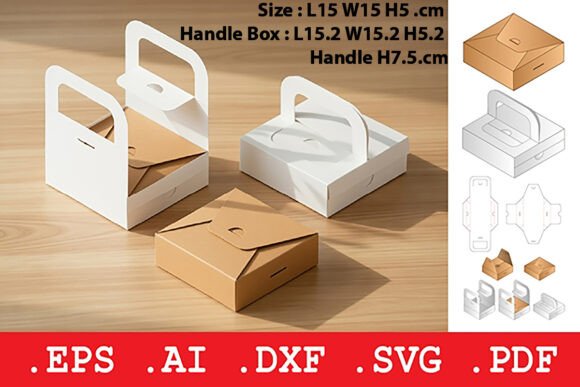
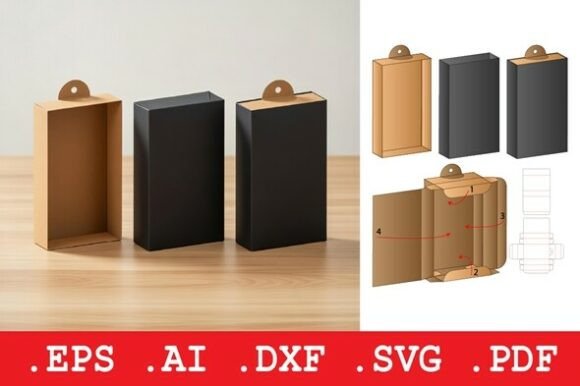
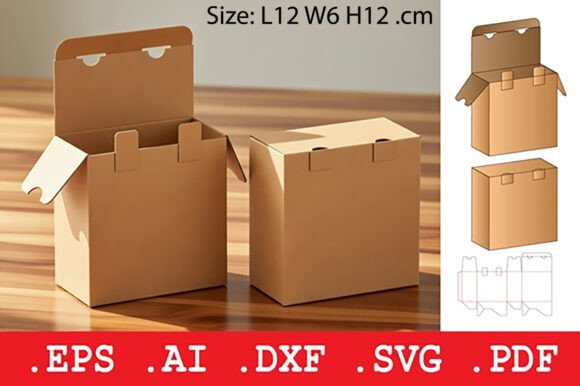
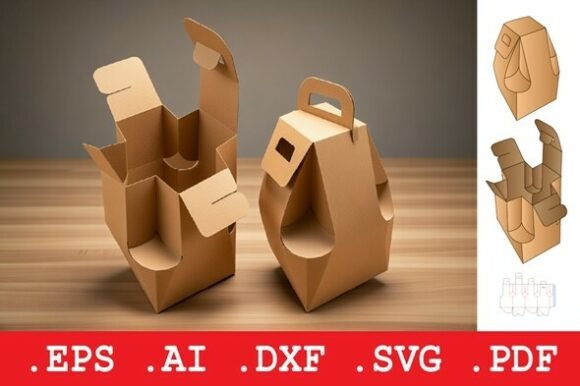
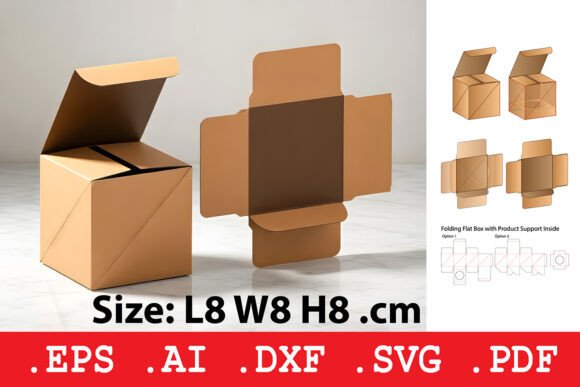
What distinguishes this template from a standard folding carton is its integrated support system. The design includes two distinct internal structure options built directly into the flat template. These are not separate pieces to be added later; they are scored and cut from the same sheet of material, typically a robust 250 to 400 gsm cardstock. When the box is assembled, these structures fold up to create elevated platforms or secure cradles within the main cavity.
The purpose is straightforward yet highly effective: to elevate the product off the base floor of the box or to hold it snugly from the sides, preventing the lateral movement and bouncing that causes damage during transit. The box itself features a compact, square base with angled folds that contribute to a low-profile, yet surprisingly sturdy, final form. A hinged lid provides clean closure, completing a presentation that feels intentional and secure.
Key Characteristics and Immediate Strengths
The primary strength of the Folding Flat Box with Product Support is its problem-specific design. It solves a known issue—internal product movement—with an elegant, integrated solution. This translates into several practical benefits.
- Damage Reduction: By immobilizing the product, it directly lowers the risk of in-transit damage, a critical metric for businesses selling fragile items.
- Enhanced Presentation: The product arrives seated within a structured interior, which conveys care and quality. The unboxing experience is improved, which is valuable for brands focused on customer perception.
- Assembly Efficiency: Despite its sophisticated function, the box assembles quickly. The internal supports fold up as part of the same process that forms the main box, avoiding a multi-stage assembly with loose parts.
- Material Efficiency: Being a flat-folding design, it ships and stores as a die-cut sheet, saving significant space compared to pre-assembled boxes.
Performance in Real-World Application
Moving from specification to practice, how does the Folding Flat Box with Product Support perform? For suitable products, its performance is reliably effective. The internal supports, when formed from the recommended cardstock weight, provide a firm but not crushing hold. For example, a glass perfume bottle seated in one of the cradle designs is prevented from tipping over and striking the box walls. A small electronic device elevated on the platform sits visibly proud, making it easy for the customer to remove while also protecting it from base shocks.
The usability hinges on the assembly process and material choice. The templates are precise; folds and cuts are clearly defined. Using the correct medium-weight cardstock is essential—too light a material will render the supports flimsy, while too heavy may make folding difficult. In practice, the 350 gsm range often offers the ideal balance of rigidity and foldability for manual assembly. The low-profile design also means the finished box doesn’t add excessive volume, potentially keeping shipping costs lower than a larger, bulkier alternative.
Flexibility and File Format Ecosystem
A significant aspect of this template’s long-term value is its flexibility, enabled by the comprehensive suite of file formats provided. Each format serves a distinct production pathway, making the template adaptable from hobbyist to industrial scale.
- The .DXF file allows direct compatibility with CNC routers and laser cutting systems, enabling precise, automated production for batch manufacturing.
- The .SVG and .EPS vector formats are invaluable for digital designers and operators of digital craft cutters, allowing easy scaling and integration into design software without loss of detail.
- The .PDF offers a reliable, print-ready format for manual cutting or viewing, suitable for small-batch prototyping or one-off projects.
- The inclusion of the original .AI (Adobe Illustrator) source file is perhaps the most powerful asset. It grants full customization access: dimensions can be adjusted, graphics can be added directly to the template, and the support structures can be modified for a uniquely shaped product.
This file ecosystem means the Folding Flat Box with Product Support is not a static product. It is a starting point that can evolve. A small business can use the PDF for initial runs, then transition to the DXF for scaled production, all while maintaining the same core functional design.
Identifying the Ideal User and Application
This packaging solution is not universal. Its value is concentrated for specific users and scenarios. Professionals and entrepreneurs selling small, fragile, or high-value items online are primary beneficiaries. This includes makers of artisan ceramics, boutique cosmetics brands, sellers of precision tools, or small electronics firms. The box provides a competitive edge in presentation and protection that generic packaging cannot.
Serious hobbyists and creators, such as those selling at craft fairs or through small Etsy stores, will find the manual assembly via the PDF template perfectly suited to their output volume. Marketers and publishers looking for distinctive packaging for promotional items or limited-edition goods can customize the AI file to incorporate branding directly into the structure. Educators teaching design or logistics might use it as a practical case study in functional packaging engineering.
The situations where it may be less optimal are for very heavy items (where the cardstock supports would be inadequate), for products requiring extreme climate or moisture protection (where specialized materials are needed), or for operations seeking the absolute lowest cost per unit where minimal, non-supportive packaging is the accepted standard.
Balanced Observations and Recommendations
Adopting the Folding Flat Box with Product Support requires a considered approach. Its effectiveness is tied to correct material selection and precise assembly. A recommendation for first-time users is to prototype. Print and assemble a single box from the PDF using your intended cardstock to test both the fit for your product and the physical robustness of the assembled form.
For businesses, the customization potential via the AI file should not be overlooked. Integrating your logo or brand colors into the template itself, rather than applying a label later, creates a deeply cohesive branded experience. Furthermore, consider the unboxing sequence. The design of the internal support can be used to guide the customer’s interaction—for example, a platform lift might present the product as a “reveal” upon opening.
A possible limitation is the learning curve for full customization. Modifying the support structures in the AI file requires a basic understanding of vector design principles to maintain the structural integrity. However, for standard use with the provided designs, no such skill is needed.
Ultimately, the Folding Flat Box with Product Support is a thoughtfully engineered response to a common packaging gap. It offers a reliable, adaptable, and presentation-enhancing solution for a defined range of products. Its value is clear for those whose business or creative output suffers from the hidden costs of product damage and mediocre presentation, providing a tangible tool to elevate both security and brand perception in a single, efficiently assembled package.