The Letterpress Invitation Mockup: A Strategic Tool for Elevating Design Presentation
In the competitive landscape of luxury event branding and custom stationery, presentation is not merely a final step; it is a critical component of client communication and value perception. The Letterpress Invitation Mockup represents a specialized asset for designers and stationers whose work resides at the intersection of digital creation and physical craftsmanship. This premium toolkit transcends being a simple visual placeholder. It is a strategic instrument for bridging the gap between a concept on screen and the tangible, luxurious artifact it aims to become.
Beyond the Screen: Simulating Tactile Luxury in a Digital World
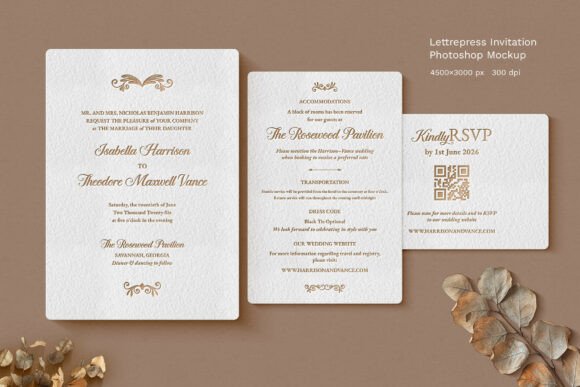
At its core, the Letterpress Invitation Mockup is engineered to solve a specific and common challenge: how to convincingly present the physical qualities of high-end print work—such as deep debossing, paper texture, and dimensional ink—within a digital proposal or portfolio. Traditional letterpress printing involves pressing ink into heavy cotton paper, creating a literal, touchable indentation. This tactile experience is a hallmark of luxury and is often a key selling point. The mockup’s high-fidelity PSD files, with their professional 4500 x 3000 px resolution, are designed to simulate this process with crystalline clarity, rendering every paper fiber and subtle shadow.
The strategic utility here is profound. For clients investing in premium wedding suites or corporate gala branding, seeing a flat digital design can leave the final outcome abstract. Using the Letterpress Invitation Mockup transforms that digital concept into a gallery-quality visual artifact within the presentation itself. This directly supports goals around client confidence and value justification. When a client can visually grasp the depth, weight, and texture of the proposed piece, they are more likely to understand—and approve—the associated investment. It turns a speculative idea into a near-tangible preview.
Intentional Application: Key Use Cases for Strategic Advantage
Understanding when and how to deploy this tool is essential for maximizing its return. Its use should be intentional, aligned with specific communication goals rather than applied randomly to any design.
Wedding Stationery Showcase
For designers specializing in bridal suites, the mockup provides an atmosphere of quiet luxury and timeless elegance. Presenting a complex invitation suite—with its main card, detail inserts, and envelope—within the mockup’s neutral, botanically-accented scene creates a cohesive narrative. This isn’t just about showing a design; it’s about presenting the entire experience the wedding guests will receive. It aids in planning the visual hierarchy of the suite and allows the designer to demonstrate how minimalist typography or intricate illustrations gain authority through simulated physical depth.
Gala and Corporate Event Branding
Event planners and branding agencies operating in the upscale market require presentation tools that match the sophistication of their concepts. The Letterpress Invitation Mockup is perfect for presenting concepts for luxury galas, award dinners, or high-stakes corporate events. Here, the tool supports brand positioning. A meticulously mocked-up invitation or program becomes a proxy for the event’s overall quality and attention to detail. It communicates a message of exclusivity and careful planning before a single physical item is printed.
Bespoke Calligraphy and Fine-Art Design
Calligraphers and artists who invest hours in hand-lettered designs face the unique challenge of translating that analog beauty into digital client presentations. The mockup’s smart-object system allows these delicate designs to be dropped in and instantly contextualized with realistic 3D depth. This highlights the craftsmanship in a way a flat scan cannot, protecting the artist’s premium positioning and helping clients see the work as a preserved art object, not just a service.
A Framework for Strategic Implementation
To rely on this tool effectively, consider a framework beyond the technical “drop-in.” Approach it as part of your overall design and client communication strategy.
- Align with Client Vision Early: Introduce the mocked-up version during the concept phase, not just at final delivery. Use it as a tool for collaborative refinement, asking, “Does this depth and texture align with the feel you’re aiming for?”
- Contextualize the Scene: The included minimalist backgrounds with soft floral accents are not arbitrary. They set a tone. Choose the scene that best complements your design’s aesthetic—whether more organic or more stark—to create a holistic mood board within a single image.
- Use for Portfolio Curation: For long-term branding, use these mockups to build a portfolio section dedicated to “Craft & Texture.” This signals a specialization and helps attract clients whose goals are inherently tied to quality and physical presence.
Potential Risks and Considerations
While powerful, the Letterpress Invitation Mockup is not a universal solution. Using it without clear goals or context can dilute its impact or even mislead.
A primary risk is creating a disconnect between expectation and reality. The mockup simulates a specific, high-end printing technique. If the final production will use a different, less costly method (like digital flat printing), using this mockup could set an expectation that won’t be met, damaging client trust. It is crucial to ensure the mocked-up presentation accurately reflects the planned production process.
Another consideration is over-reliance. The tool excels at presenting tactile print work, but not every stationery project requires or benefits from this level of simulated physicality. For simpler, digitally-focused projects, its use might feel incongruous. The decision to use it should stem from a strategic need to communicate texture, weight, and luxury.
Planning for Long-Term Value and Creative Productivity
Integrating the Letterpress Invitation Mockup into your operational workflow can yield benefits beyond a single client presentation. It can enhance creativity by allowing you to experiment with how different designs react to the simulated debossing environment before committing to physical proofs, saving time and cost. It boosts productivity by providing a ready-made, high-quality presentation template that eliminates the need to build complex 3D simulations from scratch for each project.
Ultimately, this toolkit is an investment in your brand’s capability to communicate nuance. It helps you articulate the value of craftsmanship in a marketplace often saturated with flat, digital alternatives. By using it intentionally—paired with clear explanations of the letterpress process it represents—you empower clients to make informed, confident decisions. You transform your presentation from a simple design review into a strategic consultation on materials, sensation, and lasting impression, turning digital concepts into compelling narratives for tangible, premium artifacts.